
Bio-Security

Herd management ensures a healthy herd, the cornerstone of a successful for farm. Proper Bio-Security measures gives your buyers and you a peace of mind on the health or your herd. To ensure, our entire Kiko herd tested negative tested for Johnes, CAE, and CL. On a rare occasion, if we bring a new addition to the farm, goats quarantine for 30 days and Bio-Security tested for Johnes, CAE, CL. As a preventative measure, we verify CD&T vaccination and Copper Bolus treatments. We restrict access to our herd to our caretakers to limit potential contamination from foot traffic.
Vaccinations
We vaccinate our herd once a year for CD/T, 2ml dosage. The annual booster given to our pregnant does 2 to 6 weeks before kidding provides some protection to the kids through the colostrum. Following birth, the kids receive 2ml dosages of CD&T vaccinations at 4-6 weeks of age, followed by a booster shot in 30 days. We use new syringes and needles for each vaccination and inject subcutaneously in the armpit.
Identification
Because kids can somethings switch up with another doe, we photograph newborns with their mama shortly after birth. To further mark identities, we ear tag our kids in batches when they are about 2 weeks of age rather than one at a time. 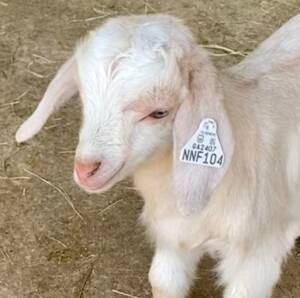 The tag is placed slightly above the middle of the ear so the tag sits centered in the ear. Be careful not to nick a vein. We attach the tag in front of the center vein. We use USDA Scrapie ear tags for all newborns. For easier field identification, we tag the boys in their left ear and the girls in their right. Why? Because girls are always right, lol. Tagging is best with two people, one to hold the kid and one to tag.
We use the Mini tags from Premier One. These are the smallest tags available that provide for two lines of text and print on both sides. After you have your Scrapie Tag number registered for your farm, you can Mini Tags here.
Breeding
Herd management begins by waiting until our does mature. No doe breeding until 18 months of age and 80lbs or the doe’s growth may be stunted and in turn negatively affecting all future kids. We prefer kidding shortly after our winter weather breaks. For us in the Piedmont area of Georgia, that means mid February. The winter weather also lessons parasite loads and appears easier on pregnant does rather than the summer heat.
We typically expose our does, depending on the summer heat, somewhere between September and October. For our kids, we move our bucklings at 90 days old to the weaning pen as they can impregnate does at that age. Our doelings are weaned between 100 – 120 days. As part of our succession plan, we retain 1 to 2 doelings each year as a future herd replacement. Our young “freeloaders” happily grow out on the farm until they mature.
We currently run four breeding bucks in four separate pastures. Never put two bucks in the same breeding pasture. They will fight over does and risk injury.

In addition, we use breeding harnesses on the boys with different color markers to let you know if a doe or buck visited another pasture without your knowledge. It happens, trust me. The main purpose is to know when a billy has covered to track gestation period.
Do not let bucklings over 90 days of age in your breeding pastures. They will beat your buck to some does and you may end up with unwanted pairings and/or DNA verification challenges.
Last but not least, your buck may be the gentlest boy in the county but DO NOT turn your back on him when he is in a pasture with his does.
Last but not least. I highly recommend that you pull DNA hair samples for EVERY buck on your farm and place in a sealed envelope, record their tag number and dam on the envelop and store it with your records. Bucks have a tendency to breakout where they don’t belong and having DNA samples that you can submit at a later date can be priceless.
Record Keeping
We keep detailed records including weights at birth, 30, 60, 90, and 1 year of age. Our goats breeding focuses on health, weight gain, and disposition.
We sort our bucklings at 6-9 months of age based on performance. As a result, we retain a few top performers for future herd sires. The remaining will be culled and sent to market, sold as pets, or bought for brush management.
We currently use the paid subscription Livestocked app for record management. Note: the free version of the app is not very useful.


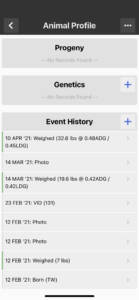
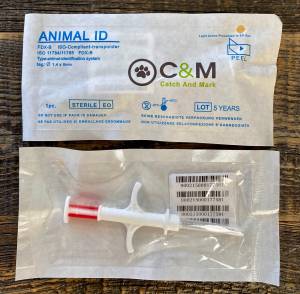
We microchip, DNA verify, and NKR register all breed quality stock.

Behavior Management
Lastly, we use various food routines to greatly enhance herd behavior. Goats are quick to learn and even a stubborn or standoffish goat can be brought around. I often have animal crackers in my pockets and use the treats to assess the goats one on one. We put out a chunk of alfalfa at feeding time for the does, not the boys. It’s a good time to assess if everyone is acting normal. Grain feeding is another assessment time to observe behavior. If anyone is being a little skittish, to make them easier to catch we put a collar on them. Once they are cookie or scratch friendly I remove it.
In Georgia, summers can get hot so if the heat index is 98+ we will mix-up a couple buckets of molasses water and sometimes add electrolytes if it is oppressively hot. Again, they come running for their buckets. We never throw out fresh veggie trimming, another free treat. Goats like routine and observing their behavior daily makes it easier to spot one who is not quite themselves. A happy healthy herd makes for a happy goat farmer. Behavior observation is your most powerful early warning in herd management!




Add Comment