
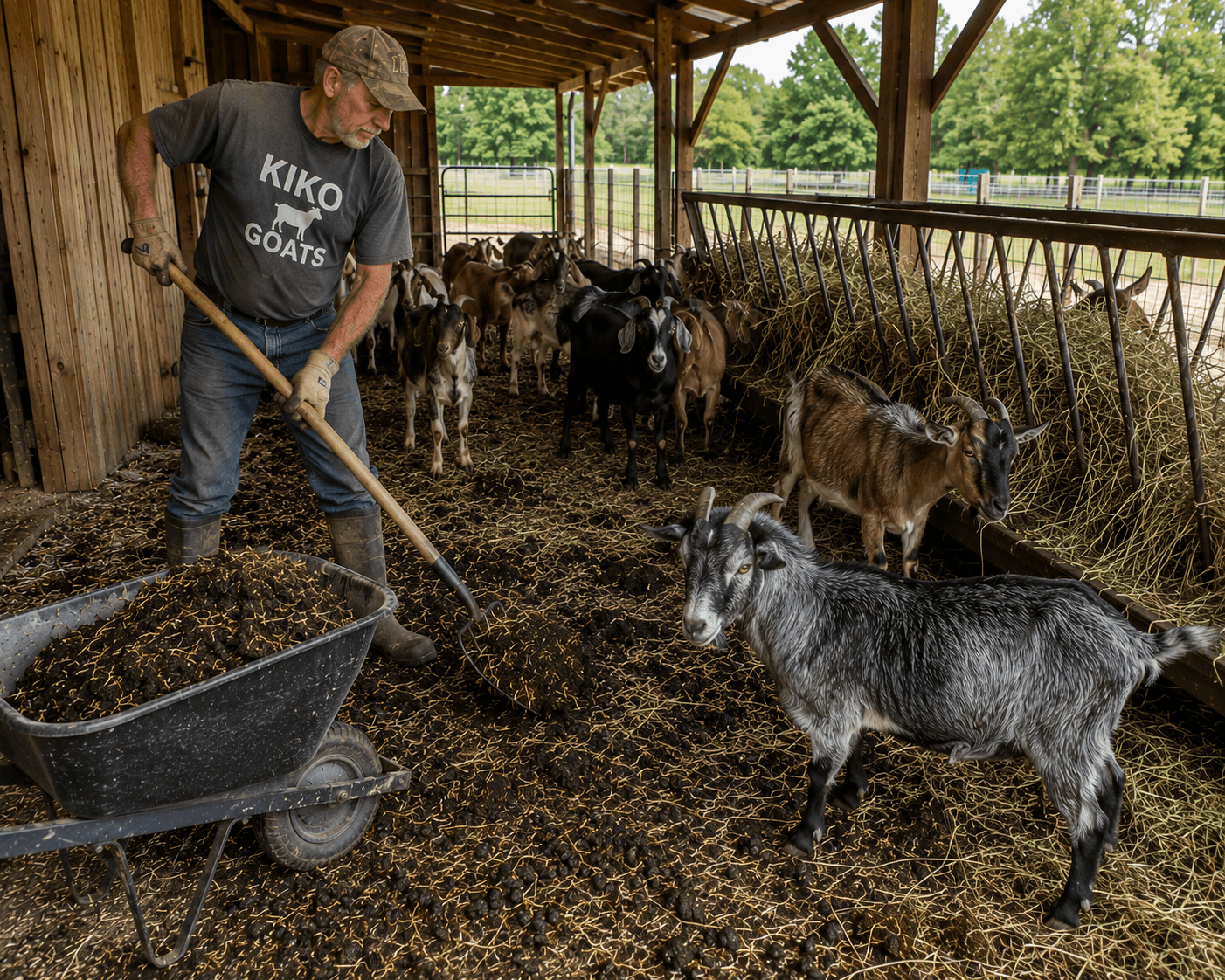
Goat Manure and Waste Hay: Turn a Farm Problem Into Better Pasture
If you raise goats, you probably have two things you never seem to run out of: manure and wasted hay.
No matter how good your hay feeders are, goats will pull hay out, sort through it, drop some on the ground, and then decide it is no longer good enough to eat. Before long, you have a mixture of hay, manure, and urine underneath the feeder and around the barn.
It may look like waste, but it can actually be a valuable resource.
Handled correctly, goat manure and wasted hay can become excellent fertilizer and organic matter for your pasture. The trick is getting those nutrients back onto the land without unnecessarily spreading parasites along with them.
Two parasites are especially important to understand: barber-pole worms and coccidia.
Fortunately, you don’t need to be a composting expert to manage either one.
Why Not Just Spread Fresh Manure?
Running fresh goat manure through a manure spreader seems like an obvious solution. It gets rid of the pile and puts nutrients back into the pasture.
There is one problem.
If your goats have barber-pole worms, their manure can contain thousands of worm eggs. Spreading that manure across the pasture can also spread those eggs across the places where your goats eat.
Warm, wet weather makes the situation worse. The eggs can hatch and develop into infective larvae fairly quickly. Those larvae eventually make their way onto grass, where goats can eat them.
If your goats continuously use the same pasture and you cannot give that pasture a long rest, routinely spreading fresh goat manure isn’t the best choice.
It is usually better to keep the manure concentrated in one place until time or composting has reduced the parasite risk.
A Simple Manure Pile Works
You don’t necessarily have to actively compost manure.
One of the easiest systems is simply having a designated manure pile.
Clean manure, dirty bedding, and wasted hay from barns and feeding areas and put it all in the same location.
There is an important benefit to doing this.
Every load you remove from the barn is manure—and potentially parasite eggs—that you are taking away from areas where goats eat, sleep, and congregate.
Instead of spreading that material across several acres, you are concentrating it in one small location.
Ideally, keep goats away from the manure pile. Adult goats occasionally walking across it isn’t necessarily a disaster, but there is no advantage to letting goats climb and lie on it.
This is especially true for kids.
Barber-Pole Worms and Coccidia Aren’t the Same
This is where manure management gets interesting.
The barber-pole worm and coccidia both leave the goat through manure, but they behave very differently once they get there.
Barber-Pole Worm
The barber-pole worm is an actual worm. It lives in the goat’s stomach and feeds on blood.
Its eggs leave the goat in their poop.
The eggs hatch and eventually develop into tiny infective larvae. Those larvae move from the manure onto nearby grass. When a goat eats the contaminated grass, the parasite gets back into the goat.
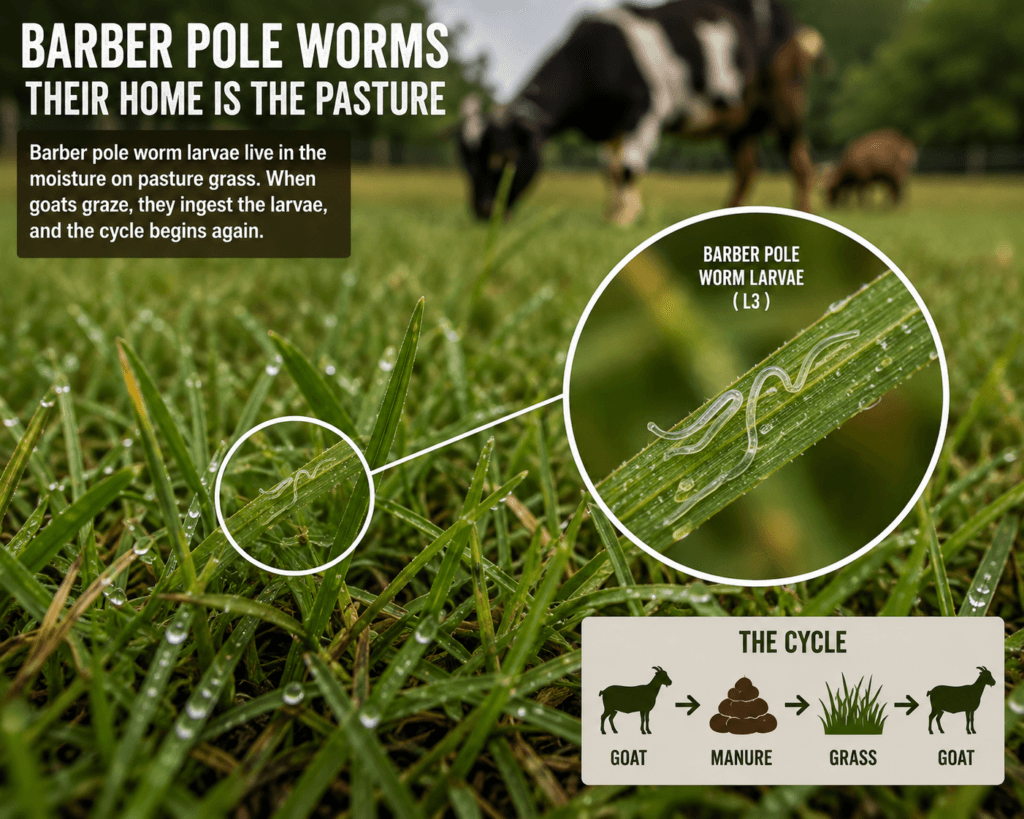
So the basic cycle is:
Goat → manure → grass → goat
Barber-pole larvae like moisture. Hot, dry conditions are hard on them.
They also don’t live forever.
That means time is your friend when dealing with barber-pole worms in a manure pile.
If you stop adding fresh manure to a pile and allow it to sit for a long period, the barber-pole larvae eventually die.
For a simple unmanaged manure pile, allowing it to sit for about a year after the last fresh manure was added gives a substantial safety margin before spreading it back onto goat pasture.
Coccidia Are Tougher
Coccidia are different.
They aren’t worms at all. They are microscopic parasites that multiply in the goat’s intestinal tract.
Goats pass coccidia in their manure, and after a short period outside the goat, they can become infective.
The biggest difference is that coccidia don’t have to climb onto grass the way barber-pole larvae do.
A goat can pick them up from contaminated feed, water, bedding, soil, feeders, or other dirty surfaces.
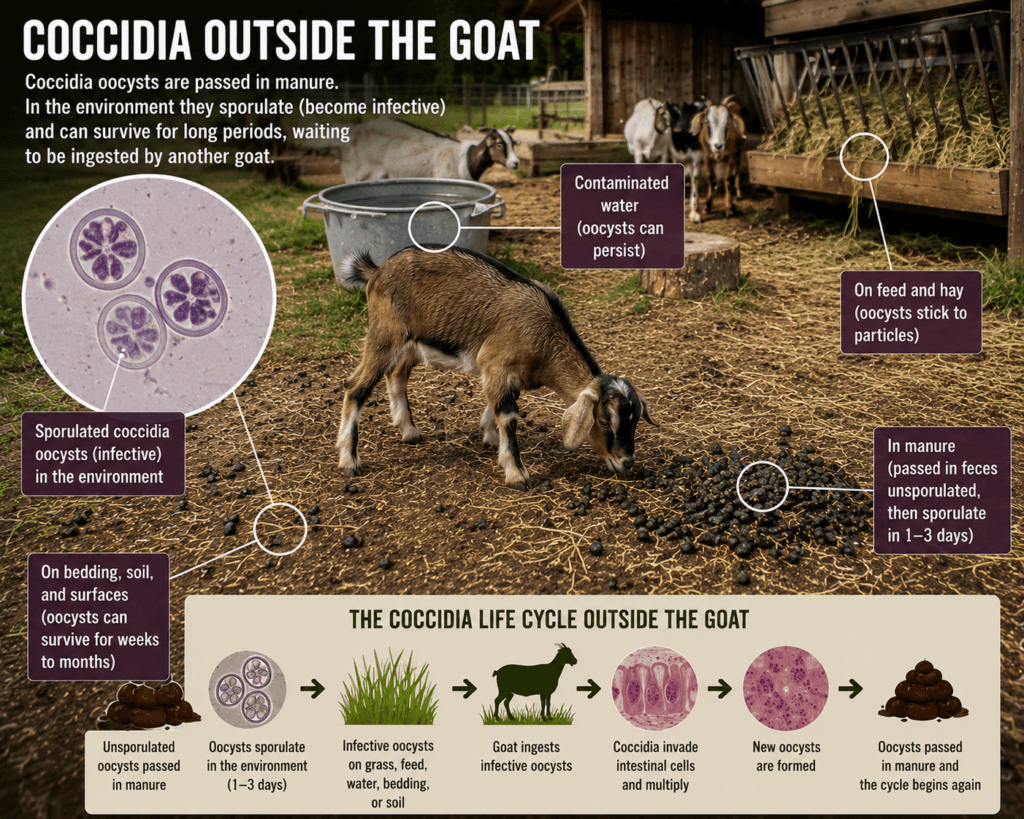
Coccidia can also survive in the environment for a long time.
That means a manure pile that has aged long enough to greatly reduce the barber-pole worm problem shouldn’t automatically be considered free of coccidia.
This is one reason composting has an advantage over simply letting manure sit.
Kids Are the Biggest Coccidia Concern
Adult goats commonly carry some coccidia without becoming sick.
Kids are another story.
Young goats have not developed the same level of resistance. When large numbers of coccidia build up around feeders, waterers, shelters, and weaning areas, kids can receive a heavy dose.
That can lead to diarrhea, poor growth, dehydration, and sometimes serious illness.
You probably aren’t going to eliminate coccidia from a working goat farm.
The goal is to keep the numbers under control, especially where kids spend their time.
Keeping manure out of feeders and water, cleaning heavily used areas, and avoiding large buildups of manure around kids can make a big difference.
Waste Hay Makes Manure Better
Here’s the good news.
That hay your goats waste is one of the best things you can add to a manure pile.
Goat manure provides plenty of nitrogen. Hay adds carbon and helps keep the pile from becoming a dense mass of manure.
More importantly, the hay creates little air spaces throughout the pile.
That air helps the organisms responsible for decomposition do their job.
The result is composting.
You may already have nearly perfect composting material underneath your hay feeders:
Waste hay + goat manure + urine
Instead of treating that mixture as garbage, scoop it up and add it to the manure pile.
The Easy Way: Let Nature Do the Work
If you don’t want another farm chore, don’t make composting complicated.
Pile the manure and waste hay together and let it sit.
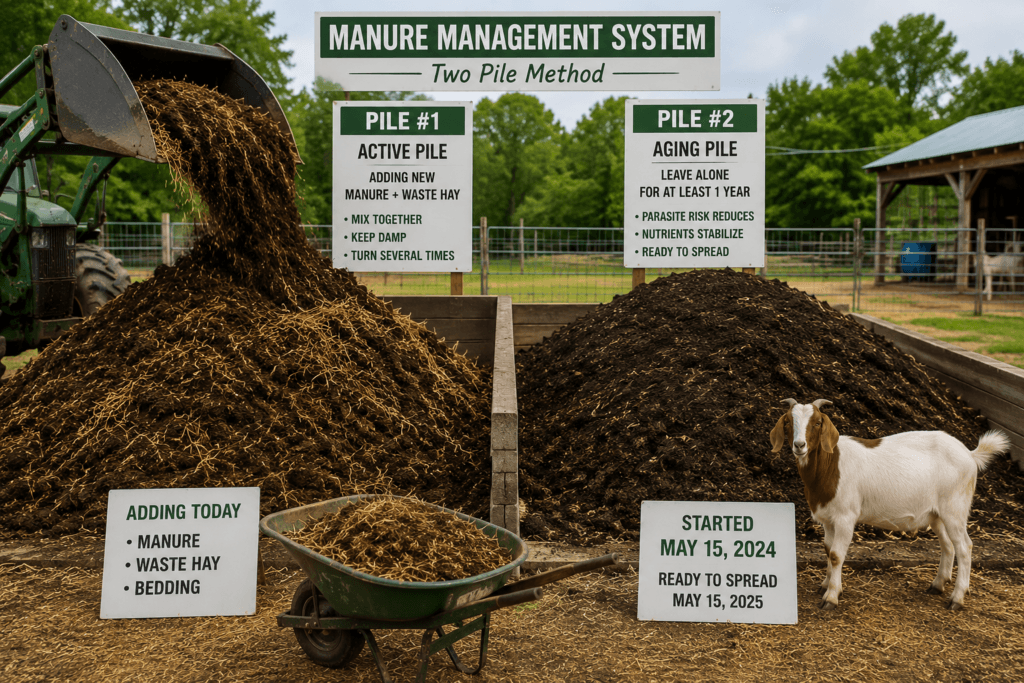
If you have enough room, use two piles.
Add this year’s manure and waste hay to Pile #1.
When you decide to start aging that pile, stop adding anything to it and begin Pile #2.
Leave the first pile alone.
After roughly a year, the risk from barber-pole worms will be dramatically lower than it was when the manure was fresh.
Then spread the old material thinly over the pasture, preferably during a period of hot, dry weather.
Meanwhile, Pile #2 is filling.
The following year, switch again.
It’s simple and requires very little extra work.
The Better Way: Help the Pile Compost
If you have a tractor with a front-end loader, you can improve the process considerably without turning composting into a hobby.
Mix the manure and waste hay together as you build the pile.
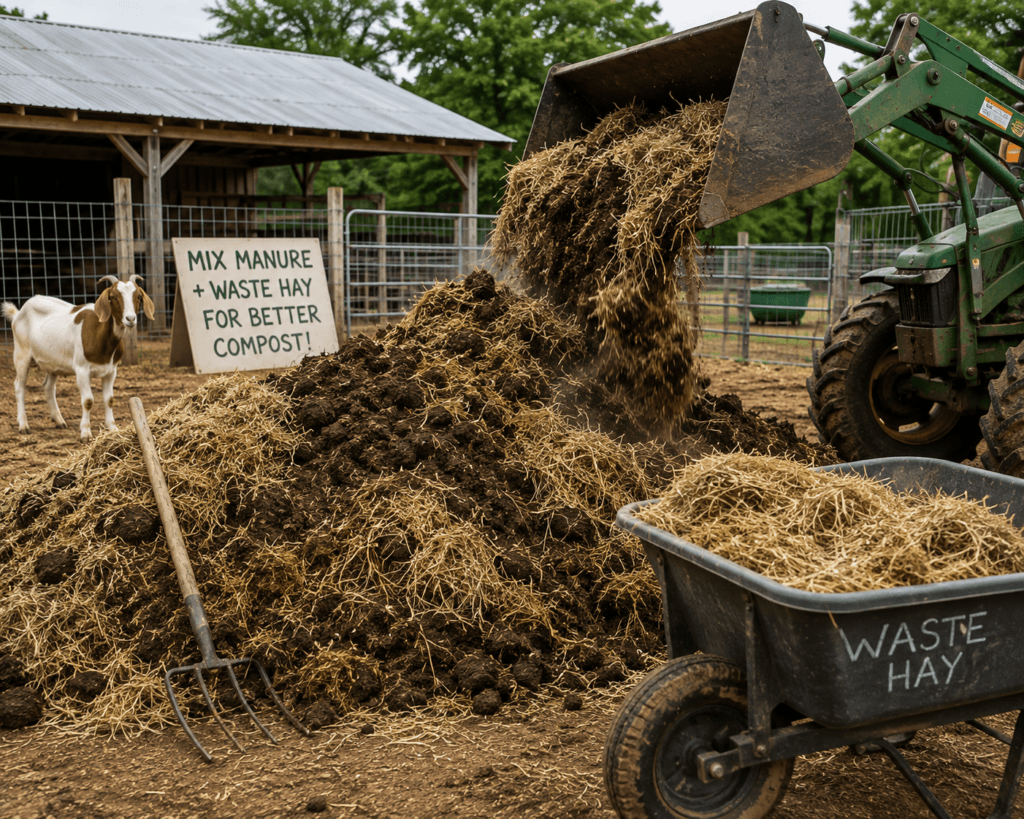
You don’t need an exact recipe. If the pile looks like nothing but manure, add some hay. If it looks like a haystack with a few goat pellets mixed in, add more manure.
The pile should also be damp.
Think of a wrung-out sponge. You want moisture, but you don’t want water pouring out of the pile.
Then let it sit.
If the mixture is right, nature takes over.
The inside of the pile will begin heating as the material breaks down. A good manure-and-hay pile can get surprisingly hot.
That heat speeds up decomposition and helps destroy parasite stages.
Turning the Pile Makes a Big Difference
The center of a manure pile may get very hot while the outside stays relatively cool.
That’s why turning helps.
Use the front-end loader to move the outside material into the middle. Then let the pile heat again.
You don’t have to turn it every week.
Even turning the pile three or four times while it is actively composting is a major improvement over never turning it.
A long compost thermometer is inexpensive and useful. Ideally, you want to see temperatures in roughly the 130–150°F range inside the pile.
That tells you the composting process is working.
Aging vs. Composting
If your biggest concern is barber-pole worms, simply aging manure for a long period works surprisingly well.
If you also want to reduce coccidia, active composting is the better choice.
Think of it this way:
Barber-pole worms don’t handle time and drying very well.
Coccidia are much tougher, so heat gives you another weapon.
Neither system makes a goat farm completely parasite-free. That’s not the goal.
The goal is to avoid taking highly contaminated fresh manure and deliberately spreading it across the same pasture where your goats are eating.
When Should You Spread It?
Once the manure has aged or composted, choose your spreading time carefully.
A hot, sunny, dry period is preferable to several days of rain.
Spread the material thinly rather than leaving heavy piles.
Sun, heat, and drying provide one more opportunity to reduce anything that may still be alive in the manure.
If possible, avoid putting questionable manure or unfinished compost into kidding and weaning areas. Those are the places where keeping contamination low matters most.
Don’t Throw Away Good Fertilizer
Goat farmers pay plenty for hay and fertilizer. It doesn’t make much sense to throw either one away. Once hay hits the ground and becomes mixed with manure and urine, it may no longer be goat feed—but it still has value. Put it in the manure pile. Over time, that messy mixture under the feeder can become dark, rich organic material that puts nutrients back into your soil.
And that’s really the goal:
Take manure and wasted hay away from the goats, let time and nature work on it, and eventually return those nutrients to the pasture instead of returning fresh parasites to the goats.
For farmers who want the simplest possible system:
Pile it → age it → spread it.
For farmers willing to put in a little more effort:
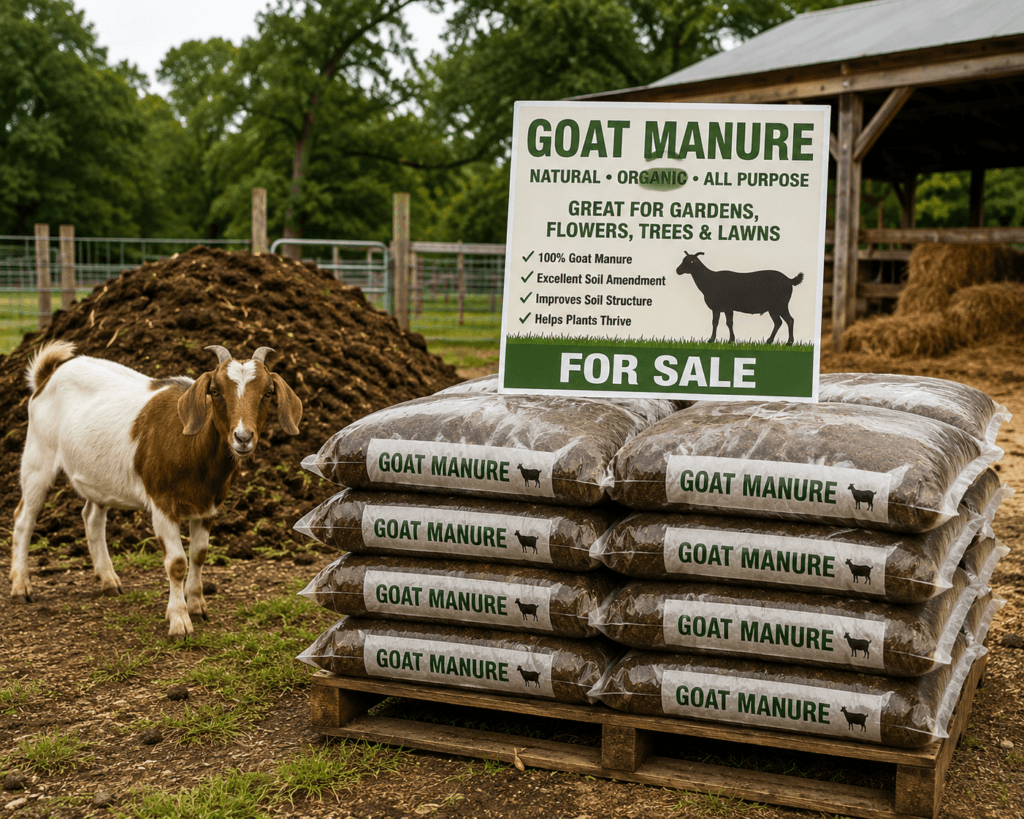
Pile it → mix in waste hay → let it heat → turn it a few times → sell it.
Either approach is better than routinely spreading fresh goat manure across a pasture that goats never get a chance to leave.
Sometimes good farm management isn’t about buying another product or piece of equipment.
Sometimes it’s simply finding a better way to use what the goats leave behind.




Add Comment